Are Smart Rings & Apple Watch HSA/FSA Eligible? Complete Guide (2026)
Short answer: Smart rings and Apple Watch are not automatically HSA/FSA eligible. But with a Letter of Medical Necessity (LMN) from your doctor, many health-focused wearables can qualify — especially if you have a diagnosed condition the device helps monitor.
The key question isn’t “is this device eligible?” It’s “can my doctor justify it as medically necessary?”
HSA vs FSA: Quick refresher
| HSA (Health Savings Account) | FSA (Flexible Spending Account) | |
|---|---|---|
| Rolls over? | Yes, indefinitely | Usually expires end of year |
| Requires HDHP? | Yes | No |
| IRS eligible expenses | Same rules | Same rules |
| Wearable coverage | With LMN | With LMN |
Both accounts follow IRS Publication 502 for eligible medical expenses. General health/fitness devices don’t qualify. Devices prescribed to monitor or treat a specific medical condition can.
The Letter of Medical Necessity (LMN)
This is the document that makes or breaks your claim. A valid LMN must:
- Name your diagnosed condition (e.g., sleep apnea, atrial fibrillation, hypertension, anxiety disorder)
- State why the device is medically necessary for monitoring that condition
- Specify the device and its relevant health features
- Be signed by your doctor (MD, DO, NP, or PA)
Example conditions that support wearable claims:
- Sleep apnea → SpO2 monitoring, breathing rate tracking
- Atrial fibrillation → continuous heart rate, ECG (Apple Watch)
- Hypertension → blood pressure trend monitoring
- Anxiety/stress disorders → HRV monitoring
- Diabetes management → activity and sleep quality tracking
Device-by-device eligibility breakdown
Apple Watch (Series 9/10, Ultra 2)
HSA/FSA case strength: Moderate to Strong
Apple Watch has the strongest case among consumer wearables because of FDA-cleared features:
- ECG app (FDA-cleared for AFib detection)
- Blood oxygen monitoring
- Fall detection
- High/low heart rate notifications
Best conditions for approval: atrial fibrillation, fall risk (elderly), heart conditions requiring continuous monitoring.
Price: $399–$799 depending on model
RingConn Gen 3
HSA/FSA case strength: Moderate
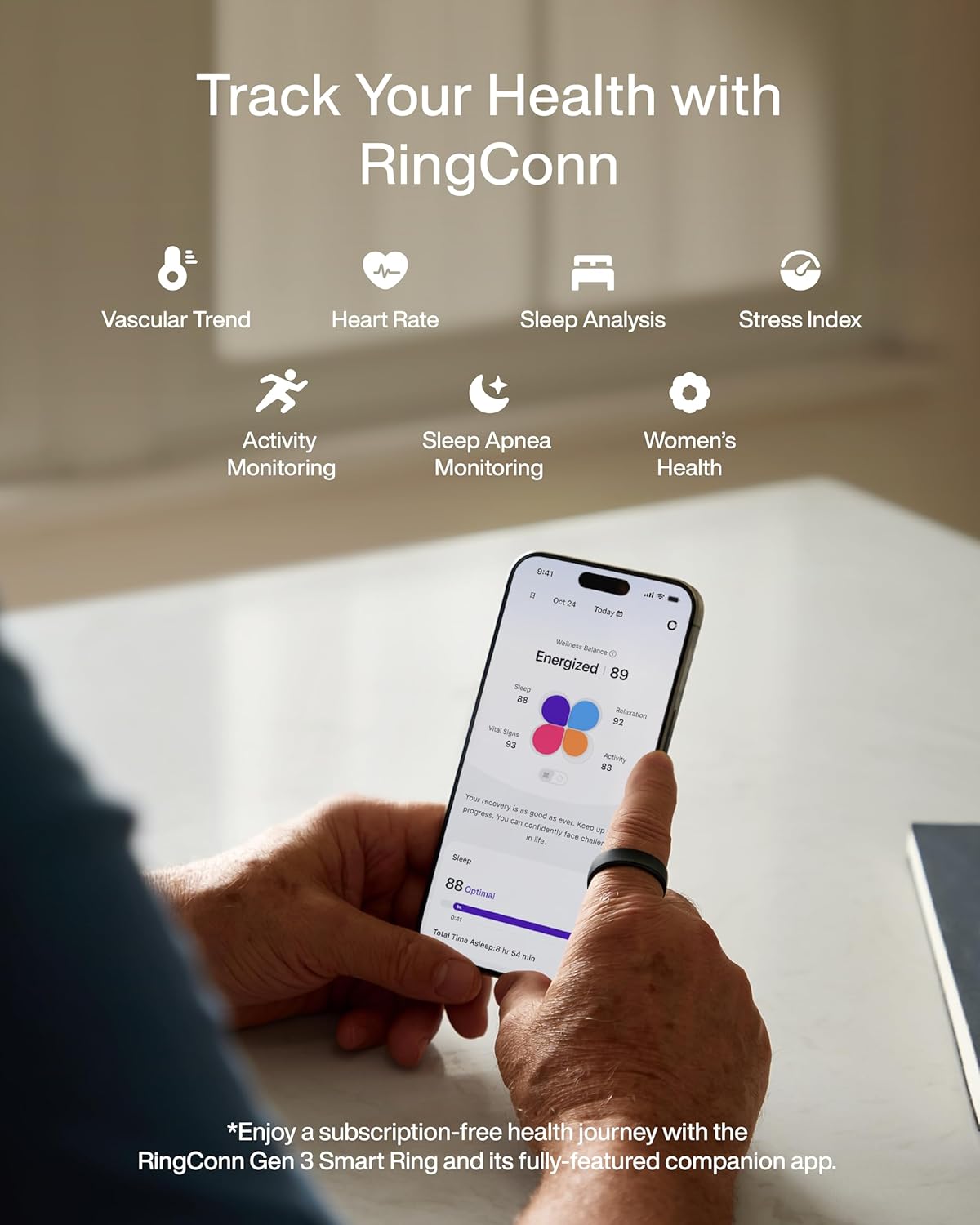
RingConn Gen 3 monitors SpO2, heart rate, HRV, breathing rate, and blood pressure trends — a comprehensive sensor suite relevant to multiple conditions.
- Overnight blood pressure trend monitoring (unique among rings)
- Continuous SpO2 tracking
- Breathing rate measurement
- No subscription (stronger case: the device IS the medical tool, no ongoing software fee)
Best conditions for approval: hypertension monitoring, sleep apnea screening, stress/anxiety disorders.
Price: $349 (one-time, no subscription)
Oura Ring 5
HSA/FSA case strength: Moderate
Oura tracks SpO2, HRV, skin temperature, and has research partnerships with medical institutions.
- FDA pathway in progress for several features
- SpO2 and temperature monitoring
- Research-backed sleep analysis
Weakness for HSA claims: The $6/month subscription complicates things — is the subscription also covered? Most plan administrators say no.
Price: $399 + $72/year subscription
Samsung Galaxy Ring
HSA/FSA case strength: Weak to Moderate
Samsung Galaxy Ring offers heart rate, SpO2, and skin temperature but positions itself more as a fitness device than a health monitor.
Price: $399
Eligibility comparison table
| Device | FDA-cleared features | Best medical case | Price | Subscription | HSA/FSA likelihood |
|---|---|---|---|---|---|
| Apple Watch | ECG, Fall Detection | AFib, fall risk | $399–$799 | None | Highest |
| RingConn Gen 3 | None (wellness) | Hypertension, apnea | $349 | None | Moderate |
| Oura Ring 5 | None (wellness) | Sleep disorders | $399 | $6/month | Moderate |
| Samsung Galaxy Ring | None (wellness) | General monitoring | $399 | None | Lower |
How to submit an HSA/FSA claim for a wearable
Step 1: Get diagnosed. You need an existing medical condition. “I want to track my health” won’t work. “My doctor diagnosed mild sleep apnea and recommended continuous SpO2 monitoring” will.
Step 2: Ask your doctor for an LMN. Bring the device specs. Explain what health metrics it tracks and how they relate to your condition.
Step 3: Purchase the device. Pay with your HSA/FSA card if possible (simplest). Or pay out of pocket and submit for reimbursement.
Step 4: Submit the claim. Include:
- Receipt/proof of purchase
- Letter of Medical Necessity
- Device specification sheet showing health monitoring features
Step 5: If denied, appeal. First denials are common. Resubmit with additional documentation from your doctor explaining medical necessity.
Tips to increase approval chances
- Buy the device for health monitoring, not fitness. Frame everything around your medical condition, not step counting or workout tracking.
- Choose devices with more health sensors. More medical-grade features = stronger case.
- Avoid bundles. Don’t buy a device with accessories that are clearly fitness-oriented (sport bands, gym cases). Buy the health monitoring device alone.
- Time it right. If your FSA expires end of year and you have unspent funds, December is when most wearable HSA/FSA purchases happen.
- No subscription is an advantage. Plan administrators are more likely to approve a one-time device purchase than an ongoing subscription.
Why “no subscription” matters for HSA/FSA
This is an underrated factor. HSA/FSA plan administrators prefer one-time purchases over recurring expenses. A $349 ring with lifetime access to health data is easier to approve than a $399 ring plus $72/year that might not be covered.
RingConn Gen 3 and Ultrahuman Ring Air both offer subscription-free models — the device purchase includes full access to all health data, forever. This makes the HSA/FSA paperwork simpler and approval more likely.
The bottom line
| If you have… | Best device for HSA/FSA claim |
|---|---|
| AFib or heart arrhythmia | Apple Watch (FDA-cleared ECG) |
| Sleep apnea | RingConn Gen 3 (SpO2 + breathing + BP) |
| Hypertension | RingConn Gen 3 (blood pressure trends) |
| Fall risk | Apple Watch (FDA-cleared fall detection) |
| Sleep disorders | Oura Ring 5 or RingConn Gen 3 |
| General health anxiety | Harder to approve — HRV-based case |
The wearable HSA/FSA space is evolving fast. As more devices get FDA clearances, approval rates will increase. For now, the combination of a clear medical diagnosis + Letter of Medical Necessity + a device with relevant health sensors is your best path to reimbursement.