How Does RingConn Measure Stress? HRV Algorithm Explained (2026)
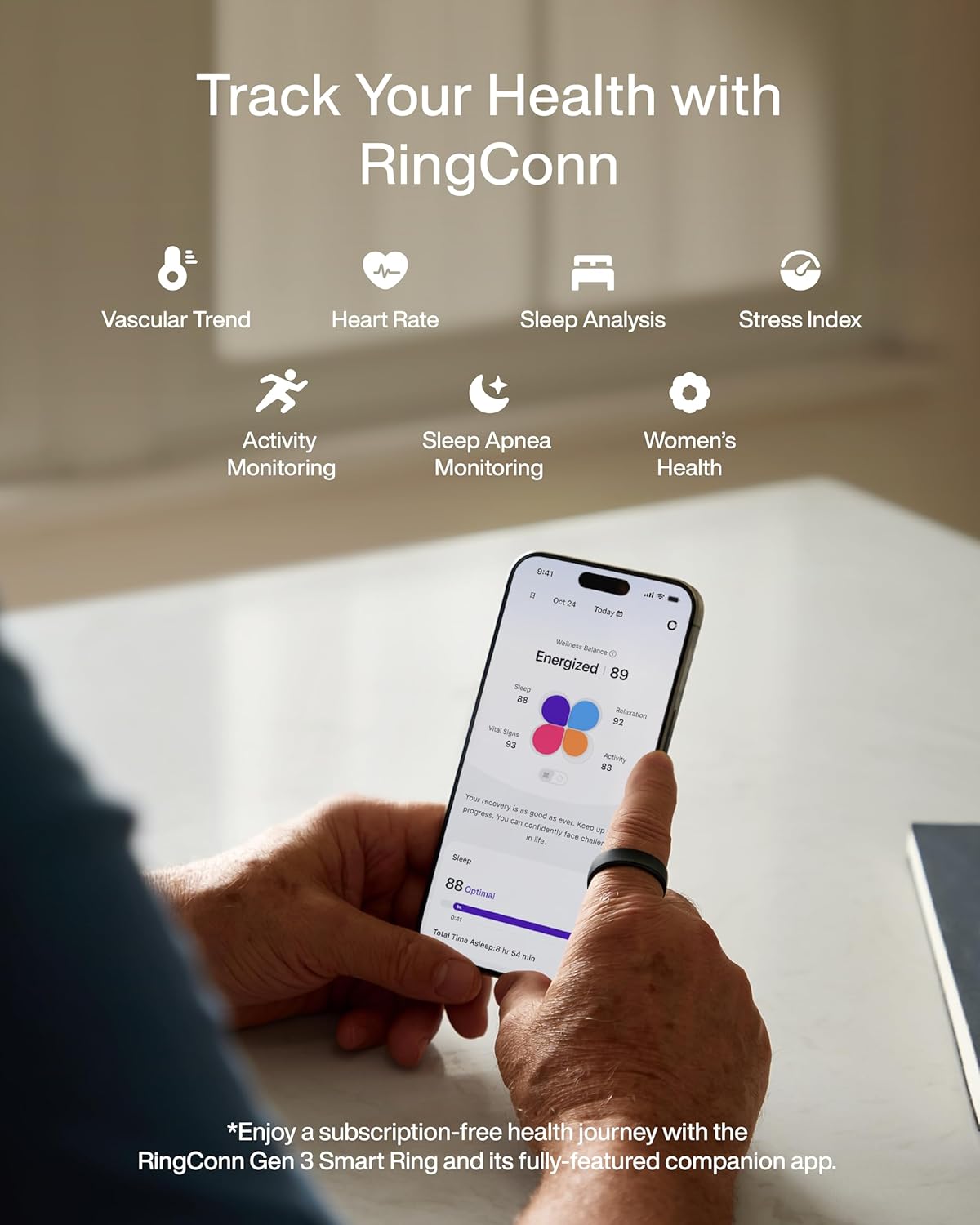
Short answer: RingConn measures stress by analyzing overnight heart rate variability (HRV) during deep sleep. Lower HRV = higher stress. It doesn’t detect real-time daytime stress — only your body’s accumulated stress load reflected in overnight recovery metrics.
What is HRV and why it measures stress
Heart rate variability (HRV) is the variation in time between consecutive heartbeats, measured in milliseconds.
High HRV (good):
- Example: Beat 1 to Beat 2 = 950ms, Beat 2 to Beat 3 = 1050ms
- Variation = 100ms difference
- Means: Parasympathetic nervous system (rest-and-digest) is active
- = Low stress, good recovery
Low HRV (bad):
- Example: Beat 1 to Beat 2 = 1000ms, Beat 2 to Beat 3 = 1005ms
- Variation = 5ms difference
- Means: Sympathetic nervous system (fight-or-flight) is dominant
- = High stress, poor recovery
Your body under stress becomes rigid and predictable (low HRV). Your body relaxed and recovered is adaptive and variable (high HRV).
How RingConn calculates stress from HRV
Step 1: Overnight HRV measurement
RingConn tracks heart rate continuously during sleep using PPG sensors (LED lights that detect blood flow). It calculates HRV specifically during deep sleep (N3 stage) when external factors are minimized.
Why deep sleep? Movement, temperature, digestion, and conscious thought all affect HRV. Deep sleep isolates the signal.
Step 2: RMSSD calculation
RingConn uses RMSSD (root mean square of successive differences) — the gold standard for short-term HRV measurement:
- Measure time between each heartbeat (R-R intervals)
- Calculate differences between consecutive intervals
- Square those differences
- Take the mean
- Take the square root
Result: Your overnight HRV number (e.g., 45ms)
Step 3: Compare to your baseline
RingConn establishes your personal HRV baseline over 2-4 weeks. Stress score is relative:
- HRV 20% below baseline = High stress
- HRV at baseline ±10% = Moderate stress
- HRV 20% above baseline = Low stress, good recovery
What affects your RingConn stress score
| Factor | Effect on HRV | Stress score impact |
|---|---|---|
| Physical training (heavy workout) | Lowers HRV 24-48 hours | Higher stress score |
| Poor sleep quality | Lowers HRV | Higher stress score |
| Illness/infection | Significantly lowers HRV | Very high stress |
| Alcohol consumption | Lowers HRV all night | Higher stress score |
| Mental/emotional stress | Lowers HRV | Higher stress score |
| Good recovery day (rest) | Raises HRV | Lower stress score |
| Consistent sleep schedule | Raises HRV | Lower stress score |
| Dehydration | Lowers HRV | Higher stress score |
Important: RingConn can’t distinguish between physical stress (workout) and psychological stress (work deadline). Both lower HRV. Context matters.
RingConn stress vs Oura vs Whoop
All three use overnight HRV but present it differently:
| Feature | RingConn | Oura Ring | Whoop |
|---|---|---|---|
| Measurement | Overnight HRV during deep sleep | Overnight HRV, weighted average | Overnight HRV, last sleep cycle emphasized |
| Score name | Stress Score | Readiness Score | Recovery Score |
| Scale | Varies (not standardized) | 0-100 | 0-100% (green/yellow/red) |
| Real-time tracking | No | No | No |
| Baseline calibration | 2-4 weeks | 3 months | 1 month |
| UI clarity | Basic | Excellent | Good |
Bottom line: All three are measuring the same thing (overnight HRV). Oura has the most polished presentation. RingConn’s underlying data is just as accurate.
Limitations of overnight HRV stress measurement
1. Not real-time
RingConn shows you yesterday’s accumulated stress, not what’s happening right now. If you have a stressful meeting at 2pm, your ring won’t reflect it until tomorrow morning’s score.
Workaround: Use patterns. If your stress score spikes every Tuesday, look for Tuesday stressors.
2. Can’t distinguish stress types
Low HRV could mean:
- You had a hard workout yesterday (good stress)
- You’re coming down with a cold (immune stress)
- You had a terrible day at work (psychological stress)
- You drank alcohol (metabolic stress)
RingConn doesn’t know which. You must interpret context.
3. Individual baselines vary wildly
Person A’s “high stress” HRV (30ms) might be Person B’s “low stress” HRV. Never compare your absolute HRV numbers to someone else’s.
What matters: Your trend. Are you consistently 10-15ms below YOUR average? That’s the signal.
How to interpret your RingConn stress data
Good use cases:
- Weekly trends: “My stress has been elevated 4 days this week — why?”
- Recovery tracking: “Hard workout Monday, stress high Tuesday, back to normal Wednesday — good recovery”
- Illness detection: “Stress score spiked for no obvious reason — might be getting sick” (often precedes symptoms by 24-48 hours)
- Lifestyle experiments: “Stopped drinking for 2 weeks, stress score dropped 20% on average”
Bad use cases:
- Daily obsession: “My stress is 5 points higher today, what’s wrong?” (Normal daily variation)
- Comparing to others: “My friend’s HRV is 80ms, mine is 45ms, am I unhealthy?” (Baselines differ)
- Real-time decisions: “My ring says I’m stressed, I shouldn’t go to this meeting” (It’s measuring yesterday)
How to improve your RingConn stress score
Your full HRV explainer covers this in depth, but quick wins:
- Consistent sleep schedule (±30 min bedtime/wake) — raises HRV 10-15%
- Manage training load — avoid 3+ hard workouts in a row without recovery day
- Reduce alcohol — even 1-2 drinks suppress HRV for 24+ hours
- Stress management — meditation, breathwork, nature time (measurable HRV improvement in 2-3 weeks)
- Stay hydrated — dehydration lowers HRV by 5-10%
The bottom line
RingConn measures stress indirectly through overnight HRV analysis during deep sleep. It’s a reliable window into your autonomic nervous system health and accumulated stress load from the previous day.
Use it for weekly trends and patterns, not daily obsession. If your stress score is consistently elevated for a week, investigate: overtraining, poor sleep, illness, life stress. Make changes, track for 2 weeks, see if the score improves.
What RingConn stress score doesn’t do: detect real-time stress, distinguish between physical and psychological stress, or provide an absolute universal scale. Your personal baseline and trend over time are what matter.