What Is HRV on a Smart Ring? How to Interpret Your Readings
HRV on a smart ring means heart rate variability: the variation in time between heartbeats, usually summarized in milliseconds (ms). Rings estimate it from pulse signals. Your reading can help you follow recovery-related patterns, but it is not a diagnosis or a universal health grade. Check data quality first, then interpret the number through your baseline, the trend, and the context.
Seeing 45 ms in an app raises a practical question: what should you do with that information? Start by checking what the label means before deciding whether the number is good or bad.
This is a research-based interpretation guide, not a hands-on accuracy test or an individualized medical assessment. Manufacturer features and the linked references were checked on September 18, 2026.
HRV, heart rate, and recovery scores are different
Your heart does not beat at perfectly equal intervals. HRV describes differences between those intervals; heart rate counts beats over time. Cleveland Clinic explains the distinction.
| App label | Typical unit | What it represents |
|---|---|---|
| Heart rate | Beats per minute (bpm) | How often your heart beats |
| HRV | Milliseconds (ms) | A calculation of beat-interval variability |
| Readiness, Recovery, or Energy | A brand-specific score, often 0-100 | Several inputs combined by the app |
An HRV reading of 45 ms and a recovery score of 85 can appear on the same morning. They use different scales. Neither number is a percentage of how healthy your heart is.
How smart rings estimate HRV
Optical sensors use photoplethysmography (PPG) to detect changes in blood volume at the finger. The device identifies pulse timing, filters the signal, and estimates variability. An ECG records electrical heart activity instead. These are different measurement methods; consumer readings should not be treated as interchangeable with a clinical ECG assessment. See Cleveland Clinic’s measurement overview.
Sleep offers relatively still recording conditions. For example, Oura describes its nightly HRV average as the mean of five-minute samples collected during sleep. That does not make overnight ring data a clinical gold standard, or mean every brand samples in the same way.
Two calculations you may encounter are RMSSD, which summarizes successive interval differences, and SDNN, the standard deviation of normal-to-normal intervals. Recording duration also changes interpretation. A brief daytime sample and an overnight average are not equivalent just because both use milliseconds. The HRV metrics review by Shaffer and Ginsberg explains these distinctions.
How to read your HRV: baseline, trend, and context
First, check whether the data is comparable
Before interpreting a surprising number, ask:
- Is this the same device, metric, and summary as yesterday?
- Does the app show missing readings or incomplete sleep data?
- Was the ring fitted according to the manufacturer’s instructions?
- Did you change devices, settings, or software recently?
Oura’s troubleshooting documentation identifies movement, loose fit, and cold hands as possible causes of gaps in its daytime stress data. That is a reason to inspect recording conditions, not evidence that every unusual HRV reading is a sensor error.
A new ring’s lower number does not, by itself, show that your health declined. Establish a history on the new device before comparing its interpretation with the old one.
1. Find your personal baseline
Your baseline is your usual pattern under comparable conditions. Use the app’s historical view rather than an online age chart as your starting point. Oura’s HRV guidance emphasizes personal history because values differ substantially between people.
If you have only just started wearing a ring, let it collect the history its documentation requires. Avoid turning the first few readings into your permanent definition of normal.
2. Look at the trend
A useful question is: does this reading resemble my recent pattern, or is it part of a change? You could compare the past week with the previous few weeks in the app. Those are convenient viewing windows, not medical thresholds.
The following examples are fictional illustrations, not clinical reference ranges:
| Situation | What 45 ms tells you | Useful next check |
|---|---|---|
| Your usual readings are 40-50 ms | It falls within your familiar pattern | Nothing about this number alone establishes a problem |
| Your usual readings are 55-65 ms | It is lower than your recent pattern | Check recording quality and recent circumstances |
| Several comparable readings have shifted lower | There is a pattern worth investigating | Review your notes and how you feel |
| You switched devices yesterday | The comparison may be invalid | Build a history using the new device |
There is no rule here that you must wait five or seven days before taking symptoms seriously. The examples help you organize observations; they do not diagnose a cause.
3. Add context before choosing an action
Record what was different: disrupted sleep, a demanding training session, alcohol, travel, a stressful day, or feeling unwell. Oura lists several of these as influences on its physiological stress analysis, which combines HRV with other signals.
A practical note might read: “Lower than my recent range; short sleep after a late flight; feel tired.” That is more useful than labeling the day “bad HRV.”
Keep explanations provisional. A number cannot tell you that travel caused the change, that you are overtrained, or that you are about to become ill. If a similar pattern repeats under comparable conditions, you have a better question to investigate.
Is higher HRV always better?
No. A higher value relative to your baseline can accompany better recovery, but a sudden increase is not automatically an improvement. Signal artifacts and irregular beats can affect variability calculations; the HRV metrics review cautions against assuming that more variability always means better health.
Apply the same checks to a spike as to a dip. Confirm the metric, inspect the recording, and consider how you feel. Do not use a reassuring ring number to dismiss symptoms.
How ring apps turn HRV into advice
HRV is an input, not the entire recovery calculation. Ultrahuman’s Dynamic Recovery explanation includes sleep, resting heart rate, HRV, skin temperature, and stress rhythm. Its HRV contributor compares the previous night with a baseline.
That distinction explains why your HRV and recovery score might move in different directions. When they do, open the score breakdown before assuming the device is contradicting itself.
| Ring or platform | Documented HRV use | Interpretation caution |
|---|---|---|
| Oura | Nightly HRV summaries; daytime stress also uses HRV | The displayed night average and daytime stress are separate outputs |
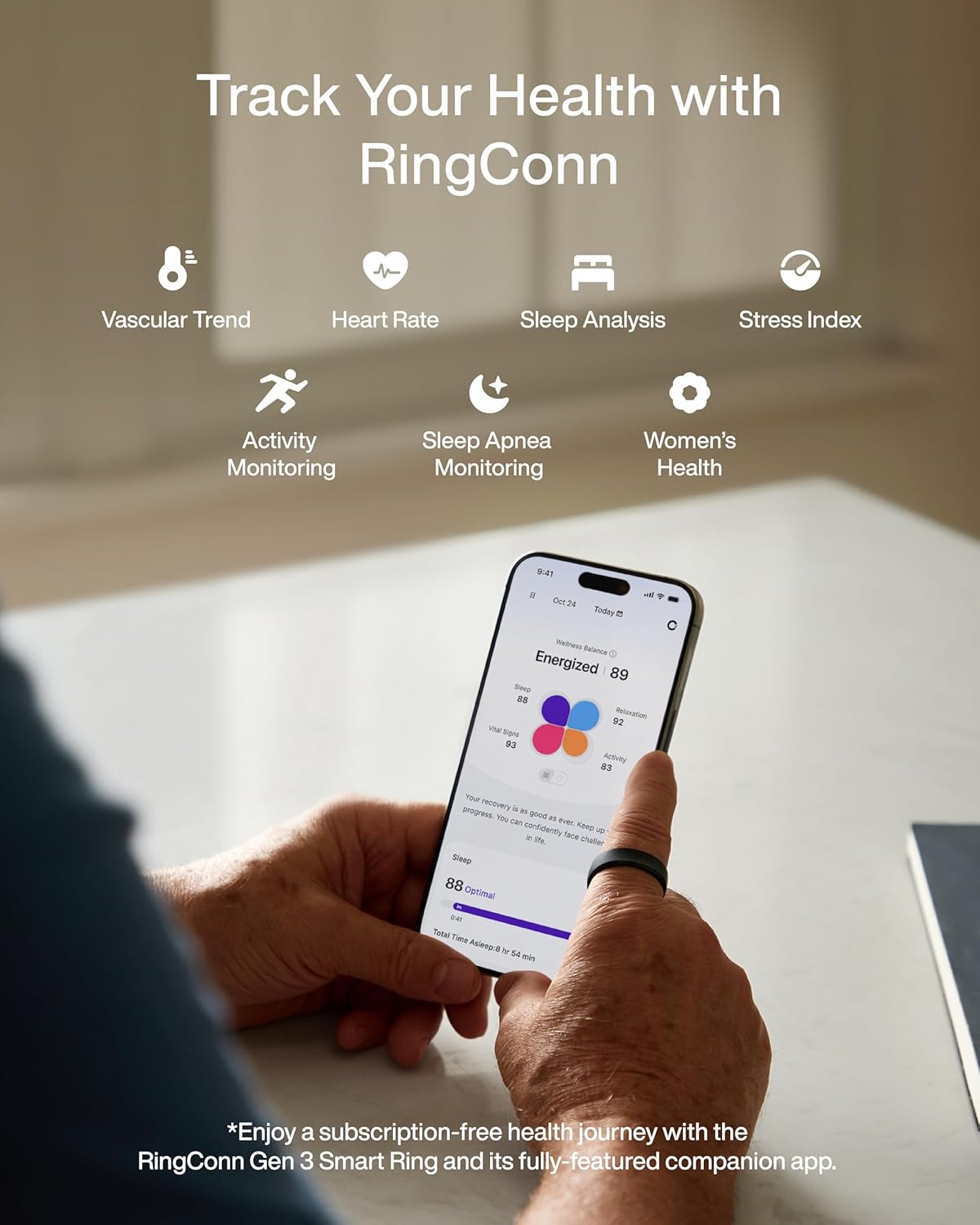
| RingConn Gen 3 | Official FAQ lists HRV within 24/7 monitoring | The claim alone does not specify a sampling interval or promise a continuous chart |
| Ultrahuman | HRV baseline contributes to Dynamic Recovery | Recovery combines several contributors |
| Samsung Galaxy Ring | Sleeping HRV contributes to Energy Score | Energy Score is a composite, not HRV in milliseconds |
This table describes functions, not an accuracy ranking. An all-day monitoring label does not establish that a product is better at estimating HRV.
For RingConn-specific reading, see our RingConn HRV guide and app overview. If you are choosing between ecosystems, our RingConn and Oura comparison covers the broader buying tradeoffs.
Can you improve HRV?
Focus on sustainable recovery habits rather than a target number. Cleveland Clinic discusses exercise, sleep, and stress management as relevant to HRV. None guarantees a specific increase in milliseconds.
For a practical observation routine, choose one manageable habit, such as keeping your sleep schedule more consistent. Note the change, keep measurement conditions comparable, and review both how you feel and the trend. Avoid changing five things at once and attributing the next morning’s reading to one of them.
Do not buy supplements, force extra training, or change prescribed medication simply to raise an app number. A useful outcome is better sleep or more manageable fatigue, even if the HRV chart does not immediately move.
When to look beyond the ring
HRV alone cannot diagnose illness, determine whether a medication is working, or clear you for exercise. Discuss persistent, unexplained changes that concern you with a healthcare professional, especially if accompanied by symptoms. Do not wait for a trend if you have chest pain, fainting, or severe shortness of breath; seek urgent medical care.
For everyday reading, leave the app with three observations: what changed, whether the data is comparable, and what else was happening. That gives you something useful to follow up without turning one measurement into a verdict on your health.