Blood Pressure Smart Rings: Which Ones Actually Work? (2026)
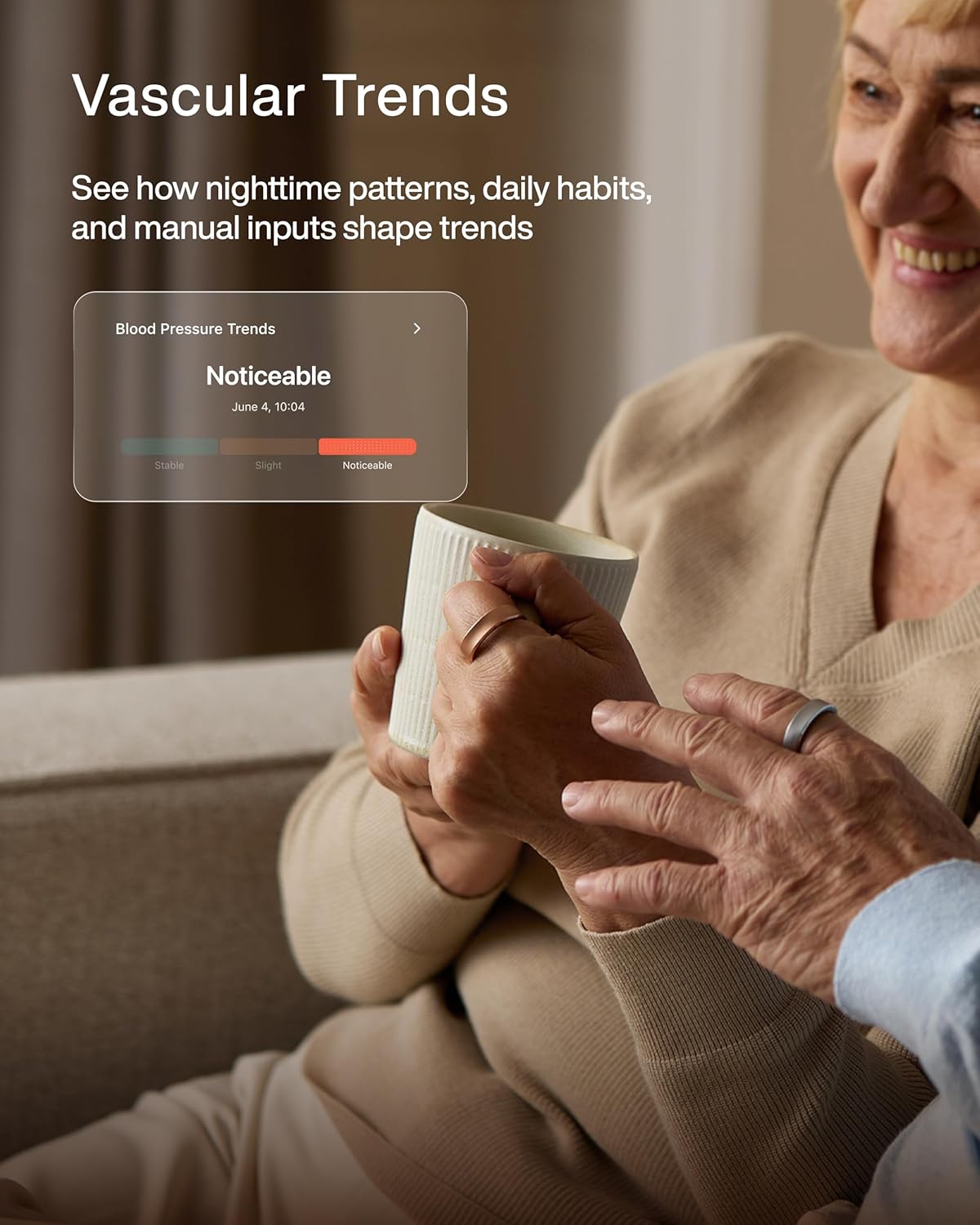
Short answer: Only one smart ring currently monitors blood pressure — RingConn Gen 3 — and it tracks overnight trends, not real-time absolute readings. No smart ring can replace a blood pressure cuff for diagnosis or medication management.
If you’re looking for a ring that gives you “120/80” readings throughout the day, that doesn’t exist yet. What exists is trend monitoring that shows whether your BP patterns are rising, falling, or stable over weeks.
How smart ring blood pressure monitoring works
Traditional blood pressure cuffs (oscillometric method) physically squeeze your artery and measure the pressure. Smart rings can’t do this — there’s no inflatable cuff on your finger.
Instead, rings use PPG (photoplethysmography) — the same green/red LED sensors that measure heart rate. Here’s the chain:
- LED light penetrates skin on your finger
- Sensor measures pulse wave — the shape and timing of blood flowing through capillaries
- Algorithm analyzes pulse wave velocity (PWV) — how fast the pressure wave travels
- PWV correlates with arterial stiffness — stiffer arteries = higher blood pressure
- Software estimates BP trend relative to your baseline
This is fundamentally different from a cuff measurement. It’s measuring a proxy (pulse wave characteristics) and inferring pressure patterns, not directly measuring pressure.
What “blood pressure trends” actually means
When RingConn Gen 3 shows you blood pressure data, it’s showing:
What you get:
- Nightly BP trend graph (relative to your personal baseline)
- Patterns over days/weeks/months
- Directional indicators (trending up, down, or stable)
What you don’t get:
- Real-time readings you can check on demand
- Absolute values (120/80 format)
- Daytime measurements
- Clinical-grade accuracy for medication adjustment
Think of it like a weather trend chart vs. a thermometer. The trend chart tells you “it’s been getting warmer this week.” The thermometer tells you “it’s exactly 72°F right now.” Both are useful, but for different purposes.
Which smart rings have blood pressure monitoring?
| Smart Ring | Blood Pressure | Method | Availability |
|---|---|---|---|
| RingConn Gen 3 | Yes (trends) | PPG pulse wave analysis | Available now |
| Oura Ring 5 | No | — | — |
| Ultrahuman Ring Air | No | — | — |
| Samsung Galaxy Ring | No | — | — |
| RingConn Gen 2 | No | — | — |
| Amazfit Helio Ring | No | — | — |
As of mid-2026, RingConn Gen 3 stands alone in offering blood pressure monitoring in a smart ring form factor.
RingConn Gen 3 blood pressure: Deeper look
RingConn Gen 3 measures blood pressure exclusively during sleep. This is a deliberate design choice:
Why sleep-only?
- Body is at rest (fewer motion artifacts)
- Consistent measurement conditions night to night
- Nocturnal blood pressure is actually more clinically predictive of cardiovascular events than daytime BP
- Research shows nighttime BP patterns better predict heart attack and stroke risk
How to use it:
- Wear the ring to sleep every night
- After 3-5 nights, the app establishes your baseline
- Subsequent nights show deviations from your baseline
- Look for sustained upward trends over weeks, not individual night fluctuations
Who benefits most:
- People with known hypertension wanting to track medication effects over time
- Those with family history of hypertension wanting early warning
- People monitoring lifestyle changes (diet, exercise, stress reduction) and their BP impact
- Sleep apnea patients (apnea causes nocturnal BP spikes)
Limitations you must understand
-
Not a diagnostic tool. A rising trend on your ring is a reason to check with a real cuff, not a diagnosis of hypertension.
-
No absolute values. If your doctor says “keep your BP below 130/80,” your ring can’t confirm you’re meeting that target. You still need periodic cuff measurements.
-
Overnight only. White coat hypertension, stress spikes, and exercise-related BP changes aren’t captured.
-
Individual calibration varies. Finger anatomy, skin tone, ring fit, and finger temperature all affect PPG signal quality.
-
No FDA clearance. This is a wellness feature, not a regulated medical device.
When to use a smart ring vs. a blood pressure cuff
| Use case | Smart ring | Blood pressure cuff |
|---|---|---|
| Tracking trends over months | Best choice | Inconvenient (manual) |
| Getting exact readings | Can’t do this | Required |
| Medication management | Supplement only | Primary tool |
| Sleep-time BP patterns | Best choice | Impractical |
| Doctor appointment data | Supportive | Required |
| Early warning of changes | Good | Only if you remember to check |
Best practice: Use both. Let the ring track nightly trends passively. Use a validated home cuff weekly or when the ring shows concerning trend changes. Bring both datasets to your doctor.
What’s coming next in ring-based BP
The blood pressure smart ring space is evolving fast:
- More competitors entering: Samsung and Apple have BP-related patents filed. Expect more rings with BP features by 2027.
- Improved algorithms: Machine learning models are getting better at extracting BP estimates from PPG signals.
- FDA pathway: Several companies are pursuing FDA clearance for wrist/finger-based BP monitoring. Clearance would transform these from “wellness” to “medical” devices.
- Calibration improvements: Future devices may pair with a cuff for initial calibration, then track deviations more accurately.
The bottom line
If blood pressure monitoring is important to you, RingConn Gen 3 is currently the only smart ring option — and it’s best understood as a trend tool, not a replacement for your cuff.
It’s most valuable for people who already know their baseline BP (from cuff measurements) and want passive, continuous monitoring to catch when things start trending in the wrong direction. Pair it with a $30 home blood pressure cuff for the complete picture: ring for trends, cuff for confirmation.